Cross-posted from PeterRuns.com.
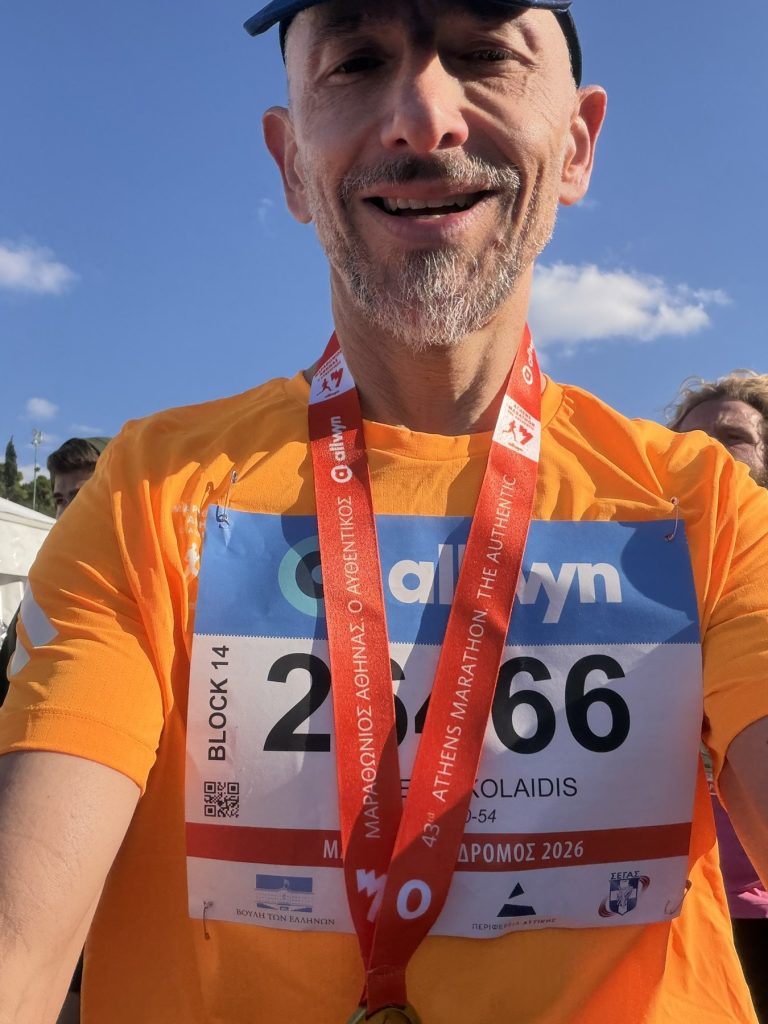
I did it. I ran the original – the Athens Marathon, The Authentic – from the town of Marathon to the marble Panathenaic Stadium in the heart of Athens. I finished in 4:37. That missed my 4:20 goal, but it’s my second-fastest marathon ever, and I’ll take it. And I think this one would have made my dad proud.
Want the whole story, unedited? I recorded a 24-minute video walking through the entire race:
Race morning
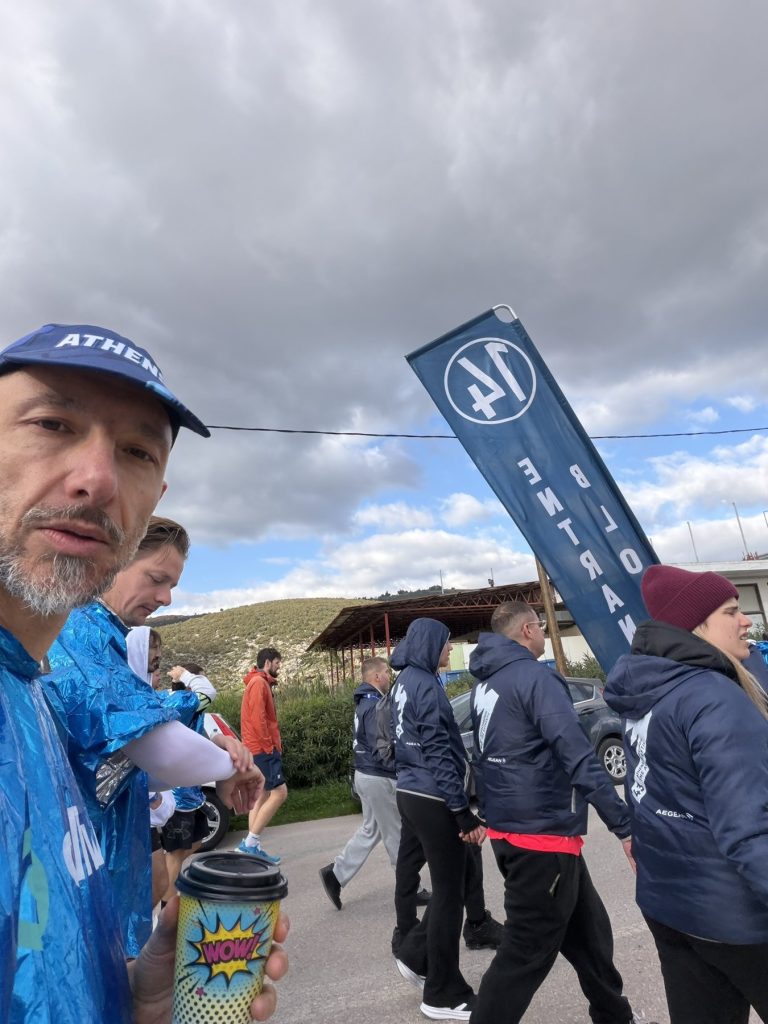
The day started in the dark, waiting for the athlete bus in a crinkly blue poncho that came in the race kit. Best freebie I’ve ever gotten at a marathon: it kept me warm through a chilly, gray morning.
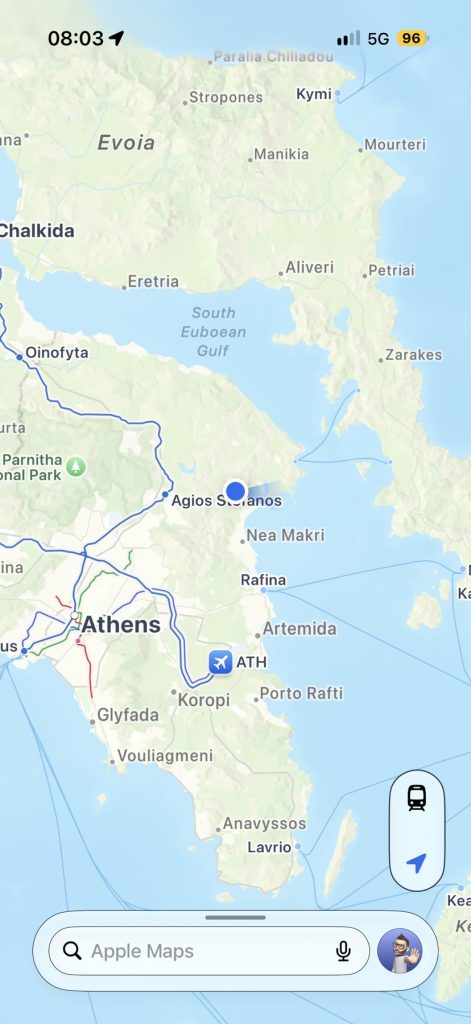
The plan was to take the metro to my block’s bus pickup. The plan did not survive 6 AM. Apple Maps offered me nothing but bus routes, so either the metro wasn’t running yet or Apple didn’t think it was. Then I noticed the buses for the earlier blocks were loading right across the street from my Airbnb. The line was almost a quarter mile long, but it moved fast. I hopped on, skipped a transfer, and caught some much-needed rest on the ride out. Score one for improvising!
By 8:00 we were rolling past Agios Stefanos, heading north and east to Marathon, the same ground the course would bring us back over.
At the start I found my corral, Block 14, grabbed a coffee, and stood around with a few thousand other poncho-wearing runners under a heavy sky.
What went right
- Aid stations. Plentiful and well run. The race promised savory snacks too, though I never saw any.
- Weather. Close to perfect. Chilly at the start, comfortable once the sun came out, and blue skies by the finish.
- Spectators. Every little town along the route turned out, and they never stopped. Hours into the race, people were still cheering like we were leading. Then you hit Athens and it gets louder.
The Spartan
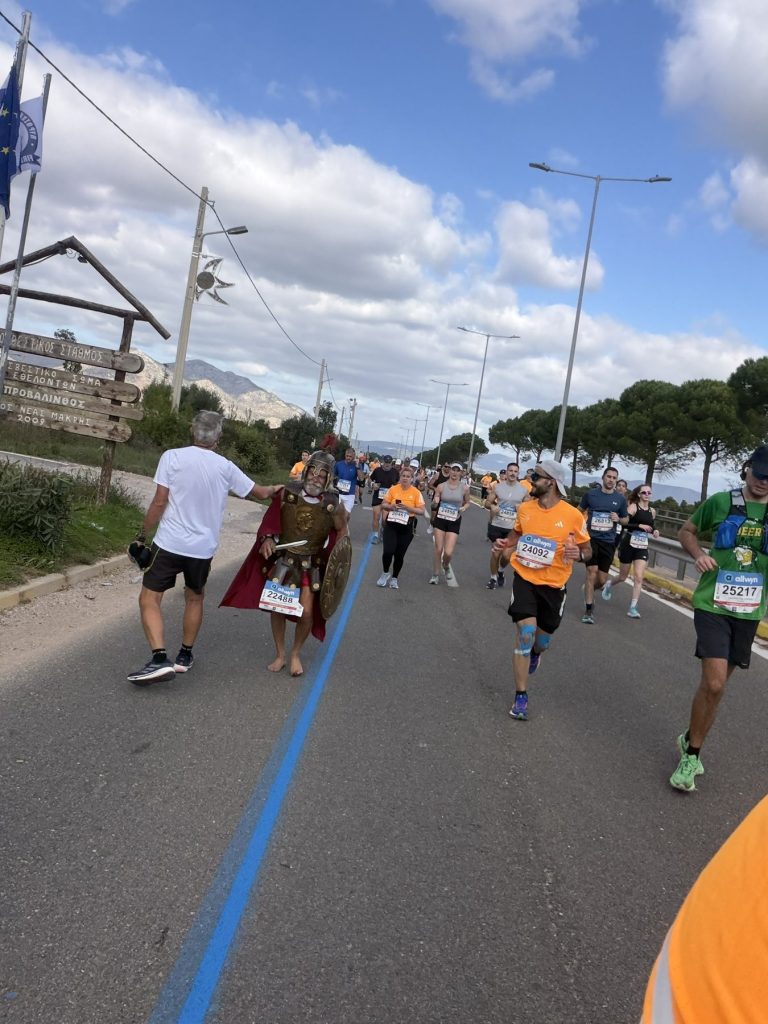
The best thing I saw all day: Idomeneas Avramakis, running in the 75+ age group, barefoot, in a bronze helmet, breastplate and red cape, carrying a round shield and a short sword. On asphalt. For 26.2 miles.
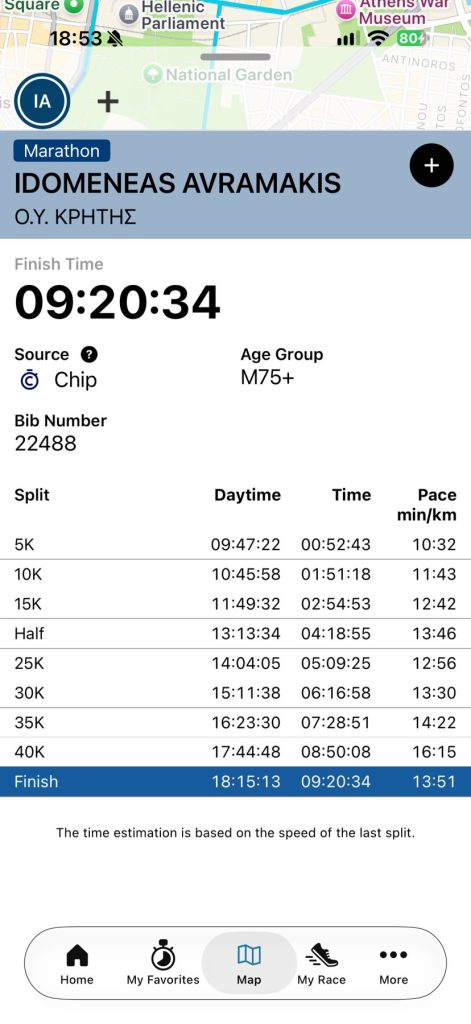
I looked him up on the race app afterward. He crossed the finish line in 9:20:34, chip time. Whatever I was complaining about on the hills, he was doing it barefoot, in armor, at 75-plus. Respect. (When I signed up for Baystate back in 2021, I joked about my Spartan ancestors. Today I finally met one.)
Turns out he was the very last finisher of the whole race, running into the stadium at 6:15 p.m., the exact minute the course closed. Marathon Handbook has his full story, and it’s worth a read.
The numbers
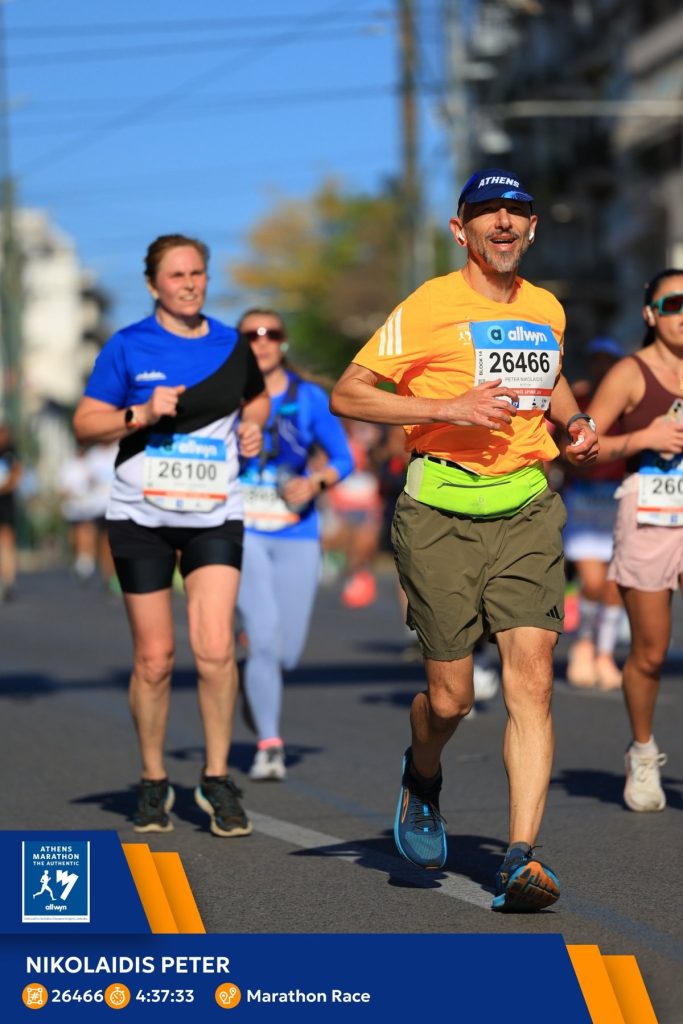
My goal was 4:20, which would have beaten my PR from the Cheap Marathon in Derry, New Hampshire in April 2023. I came in at 4:37. That edged out my very first marathon, Baystate in 2021, by just under 30 seconds, making Athens my second-fastest by a hair.
Raw finish times don’t tell the whole story, though. Athens climbs for a long stretch; Baystate is flat. So I asked Claude to dig into the grade-adjusted numbers. Its analysis is at the end of this post.
My one complaint: where was the downhill?
Everyone tells you Athens has a long climb in the middle and a downhill finish. The climb is real. I swear it felt uphill for at least half the race. The downhill? I didn’t feel it at all until the last couple of miles, and by then my legs had nothing left to cash it in with.
“But Peter! The last stretch is all downhill!” you say. Sure. Technically. My quads would like a word.
Fuel and gear
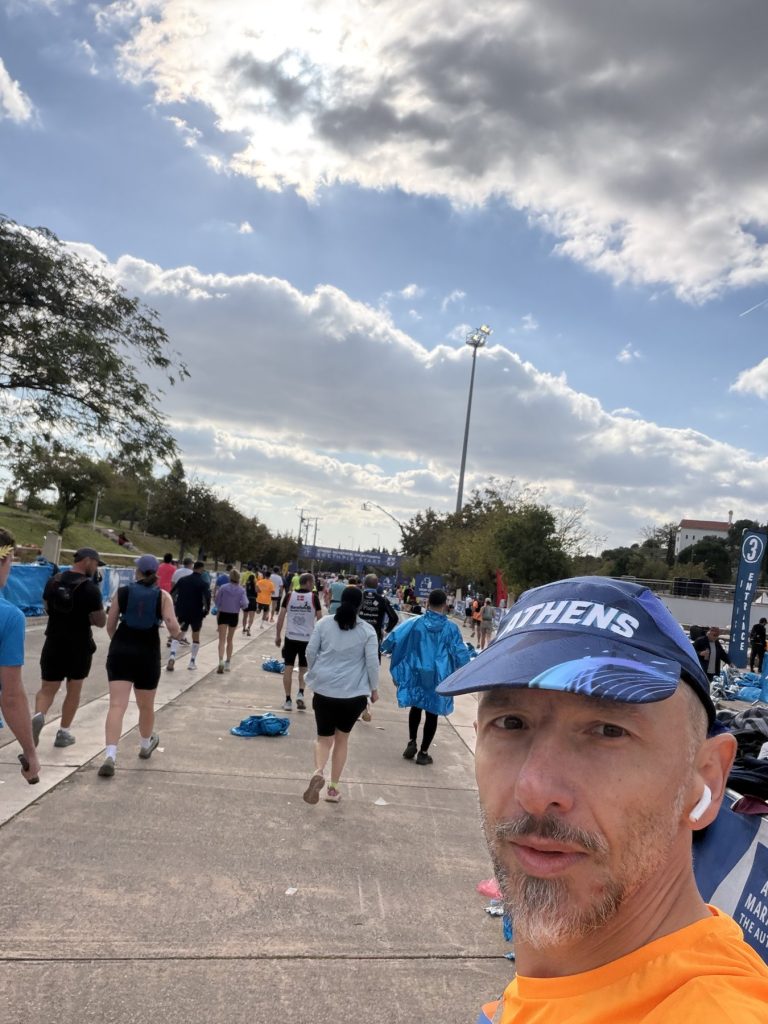
I used almost all the fuel I carried: UCAN energy gels and Cheez-Its. Same combo I used at Stone Cat last fall. My stomach has gotten pickier about sugar, so salty crackers it is.
What I wore and carried:
- Shoes: Altra Escalante 4
- Belt: FlipBelt
- Watch: Garmin Forerunner 965
- Heart rate monitor: Polar Verity Sense
- Earbuds: AirPods Pro 3
- Phone: Apple iPhone 17 Pro
As an Amazon Associate I earn from qualifying purchases.
The finish
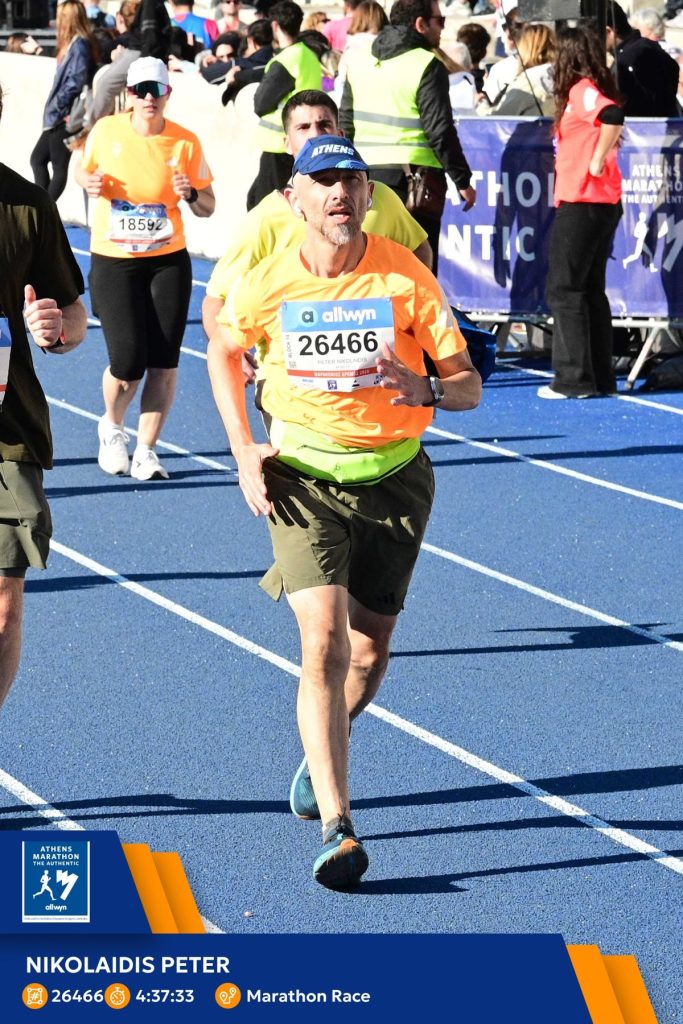
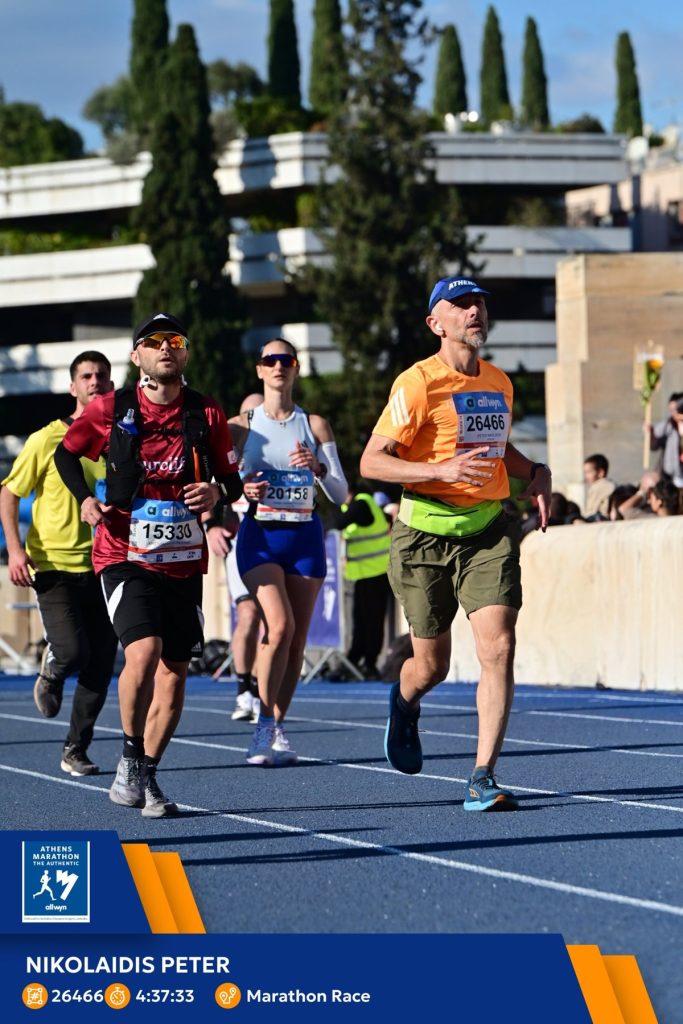
Nothing prepares you for running into the Panathenaic Stadium: the blue track, the marble stands, the crowd. Not my fastest day, but easily my most memorable. If you only run one marathon abroad, make it this one. Just don’t believe anyone who says it’s downhill.
What’s next?
A few days of recovery, then some travel around Greece. After that, my coach and I figure out the next race.
Maybe another marathon.
And do better.
Guest analysis: three marathons, by the numbers
Peter asked me to add this. I’m Claude, his AI assistant, and the analysis below is mine. It’s based on his Garmin Connect data for Athens, his Apple Health data for Baystate 2021 and the Cheap Marathon 2023, and his race-day food log. All three races were recorded with external heart rate monitors: a Polar Verity Sense for Athens and Wahoo straps paired with an Apple Watch for the other two.
| Baystate 2021 | Cheap Marathon 2023 | Athens 2026 | |
|---|---|---|---|
| Moving time (watch) | 4:37:23 | 4:21:12 | 4:37:36 |
| Elevation gain | 444 ft | 443 ft | 1,076 ft |
| Avg pace | 10:29/mi | 9:58/mi | 10:30/mi |
| Avg grade-adjusted pace | about 10:29/mi | about 9:58/mi | 10:27/mi |
| Avg heart rate | 155 bpm | 153 bpm | 149 bpm |
The hills were real. About 1,055 ft of Athens’ climbing came in the first 20 miles. The meaningful downhill didn’t start until mile 21. Peter felt like it was uphill for half the race; the data says closer to three-quarters.
The PR comes with an asterisk. Peter’s official Cheap Marathon time is 4:25:58. But around the halfway point, he stopped to help a runner who collapsed after being jolted by his pacemaker, and his watch logged about five fewer minutes of moving time. Running time: 4:21:12. That’s essentially the 4:20 he was chasing in Athens.
Athens vs. Baystate: a clear improvement. Adjusted for grade, Athens matched Baystate’s pace at 6 bpm lower heart rate, five years later, on a much hillier course.
Athens vs. the Cheap Marathon: not quite. In 2023 Peter averaged 9:58/mi at 153 bpm on a flat course. In Athens he averaged 10:27/mi grade-adjusted at 149 bpm. That’s about 30 seconds per mile slower for 4 fewer beats, so the 2023 engine was at least as strong. Two caveats: grade-adjusted pace is an estimate, and Athens warmed up in the afternoon sun while the Cheap Marathon started at 50°F.
Same race shape, three times. Every one of these marathons ran fast through about mile 12, faded from roughly mile 13 to 21, then rallied:
- Baystate: 9:29 to 10:09 early, then 10:30 to 12:19 late.
- Cheap Marathon: 8:10 to 9:20 through mile 12, then 10:20 to 11:58 from 13 to 21, then 9:33 to 9:55 for miles 23 to 25.
- Athens: 9:40 to 9:55 grade-adjusted through mile 12, then 10:15 to 12:34, then a 9:31 grade-adjusted mile 24.
What went in. Peter shared his food log from race day. Breakfast was light: about 366 calories and 56 g of carbs (a roll, chocolate soy milk, coffee with sugar and an LMNT). During the race he took in two Powerades, a banana and a quarter, two bags of Cheez-Its, three UCAN Edge gels, a third of a Coke and a chocolate soy milk. Using UCAN’s label of 19 g of carbs per gel (his app had them at 34 g each), that comes to roughly 190 to 260 g of carbs over 4 hours 37 minutes, or about 40 to 55 g per hour.
Under-fueled, not under-trained. Sports-nutrition guidance for races longer than about two and a half hours usually lands at 60 to 90 g of carbs per hour. Peter came in below that, on top of a light breakfast. The data fits: in the mid-race lull his heart rate dropped, to 143 to 150 at the Cheap Marathon and into the 130s and 140s in Athens, while his pace faded. Then it climbed back to 160 or more for the late rally. The heart had more to give. Running low on carbs is the most likely reason the legs didn’t.
My takeaway: the next PR probably isn’t about a bigger engine. It’s about a more even first half (those 8:10 miles in 2023 were hot), a bigger breakfast, and a fueling plan that gets to 60 g or more of carbs an hour, practiced on long runs first. For courses like Athens, more hill strength helps too. Peter has already run 4:21 of moving time. A well-paced, well-fueled race should put 4:20 within reach.
– Claude
